Showing posts with label lager. Show all posts

Touring the Rhine-Main Region's Oldest Private Brewery

"Next week, it smells like beer." These were the words brewmaster Stefan Simon uttered as he led me up a wooden staircase to the malt house at Privatbrauerei Glaab. It wasn't a particularly surprising statement. I've heard similar expressions from brewers before, just not in Seligenstadt, Germany. To be honest, I'd scarcely heard of the town itself until I arrived on a sunny afternoon in late August. But after several days of touring the state of Hesse on a trip sponsored by the Frankfurt Rhine-Main Region, I was excited to be anyplace where I could taste beer and talk shop. Fortunately, Mr. Simon had graciously agreed to show me around the historic brewery. 

Founded in 1744, Glaabsbräu grew steadily over time, reaching the point of producing more than one million barrels a year by 1970. And they remained independent into the 80s and 90s, as other nationally-known brands fell victim to mergers and buy-outs. More recently, the company has scaled back, currently kegging and bottling closer to 33,000 barrels annually. Even so, their footprint in this little town of half-timbered houses is considerable, seeming to occupy nearly as much real estate as the former Benedictine monastery on the banks of the Main River.

"The focus now is on quality," Simon explained in thickly-accented English. "And time for maturation is longer these days."

As he led the way back downstairs to the open fermentation cellar and then into the lagering cellar below, he told me that their Pilsener (4.9% ABV) is the top seller overall while Glaabsbräu Radler (2.6% ABV) is "popular with ladies." He also filled me in on Vitamalz, an alcohol-free malt beverage developed in 1930 that Simon described as healthier than Coke. I knew something about the beverage, having washed down boiled sheep's head with a can of Egils Malt in Iceland, so I didn't press him for more information. Besides, I was mostly there for the beer.

13 Frighteningly Good Halloween Beers

October can be a strange time for beer drinkers. Alongside any number of Oktoberfest lagers, you'll occasionally find a saison or a summer ale if the month starts off warmly, only to be replaced by a variety of pumpkin beers, redolent with pie spices and the flavors of fall. By the last week or two though, darker porters and stouts begin to creep into most draft lineups, signaling colder nights ahead. And of course October also brings Mischief Night and Halloween, two excellent opportunities for brewers to tap into their spooky side by giving their products creepy names and labels. With that spirit (pun intended) in mind, I've chosen to list some of my favorites:
  1. Vampire Ale—City Steam Brewery Cafe, Hartford, CT
  2. Dark o' the MoonElysian Brewing Company, Seattle, WA
  3. Evil Twin—Heretic Brewing Company, Pittsburg, CA
  4. Voo Doo American Stout—Left Coast Brewing Company, San Clemente, CA
  5. Certified Evil—Lucky Bucket Brewing Company, La Vista, NA
  6. Pendle Witches BrewMoorhouse's Brewery, Burnley, UK
  7. Rosemary's Baby—The Peekskill Brewery, Peekskill, NY
  8. Three Skulls Poison—Pillager's Pub, Seattle, WA
  9. Black Cat StoutThe Portsmouth Brewery, Portsmouth, NH
  10. Zombie Dust—Three Floyds Brewing Company, Munster, IN
  11. Redrum Imperial Red Ale—Trinity Brewhouse, Providence, RI
  12. Hop ZombieUncle Billy's Brew & Que, Austin, TX
  13. Hobgoblin—Wychwood Brewery, Witney, UK

Beer for the Beach

For years, Corona has shrewdly marketed itself as the beer to order at any beach, anywhere, claiming to possess "the unparalleled flavor of relaxation." Whatever that means. Personally, television ads featuring tropical shorelines and a soundtrack of crashing surf won't persuade me to buy a bottle of fizzy corn juice disguised as alcohol. Besides, I'd rather drink something brewed locally. Which is why I was happy to share some of my recent beach beer finds in the September issue of Travel + Leisure Southeast Asia.

No, Grupo Modelo's popular lager isn't particularly hard to come by in Thailand, Cambodia, or Vietnam, but given the choice, I'll take a fruity Red Ale or a citrus-tinged Passion Beer at Nha Trang's Louisiane Brewhouse any day of the week. Reserve an umbrella and a beach chair with views of the South China Sea for 35,000 Vietnamese đồng (about $1.68) and spend a leisurely afternoon choosing a favorite by working your way through their tasting tray ($4.80 for four 200 ml glasses). Or, if you find yourself island hopping in Cambodia and craving some refreshment with a shade of bitterness, ask for Clouded Leopard Pilsener (usually around $2), made by Kingdom Breweries in Phnom Penh. The mildly spicy Saaz and Hallertau hops used in this beer mean that even without a wedge of lime, you can count on plenty of taste.

Chicken and Beer in Bacolod City

The place was called Chicken House. My host, Lyn Balboa, had taken me there to try chicken inasal, a dish many Negrense, or Filipinos from the island of Negros, consider a delicacy. This is because it's the best barbecued poultry you will ever taste. Succulent, immensely flavorful (thanks to a lengthy marinade), and served with vinegar, it's a must try for anyone traveling to Bacolod City, the capital of Negros. Unsurprisingly, chicken inasal also goes well with beer.

Most of the suds you're likely to drink in the Philippines are made by the same giant brewery: San Miguel. By their own estimate they control about 95 percent of the domestic beer market. What I didn't know before visiting the City of Smiles however, is that for the past three years, one entrepreneur has quietly been producing his own beers and distributing them locally. As luck would have it, Lyn knew the brewer and invited him to join us at the Chicken House.

"I had this dream ever since college," Felix Hagad told me as he sat down at our table, "it's been a slow process and I had to make my friends taste bad beer in the beginning. I couldn't get it to bubble enough."

Fortunately for his friends—and globetrotting beer travelers like me— those days are well behind him. I didn't try the Bogsbrew Classic (somewhat confusingly offered as an IPA, a Canadian blonde ale, a European lager, and a Mexican-style cerveza), but I liked his Primo all-grain beer, a cloudy, light bodied drink that weighs in at about 4.5 % ABV. I detected a trace of hops in the nose, and it ended with a sweet finish, probably owing to the wild bee honey and organic muscovado sugar that Felix adds to his wort. Overall, Primo is mellow and sessionable, although it could benefit from a bit more carbonation.

Nevertheless, the popularity of his craft brews has only increased since he realized his dream, even attracting the attention of a Canadian beer blogger. "Business is picking up," Felix wrote in a recent email. "I now have to brew an extra batch of Primo in between my normal cycle of brewing malt extract beer." With a furniture manufacturing company to run in addition to Bogs, it must be challenging to keep up with the growing demand for his Filipino beers. And yet something tells me I'm not the only inasal devotee who wants to see his labor of love succeed.

A Layover for Beer Lovers

My first visit to Berlin lasted all of 15 hours. Looking for flights from Bangkok to New York a few weeks earlier, I had found a decent fare on airberlin that involved a layover at Tegel Airport (TXL). Initially I was reluctant to purchase the one-way ticket, thinking a mere overnight stay in the German capital wouldn't necessarily be the best introduction to a city I hadn't been to before. But then an Internet search led me to Brauhaus in Spandau, a hotel and brewpub roughly 20 minutes from the airport by taxi.

And so, shortly before Memorial Day, I found myself climbing the stairs to a clean, comfortable room overlooking the brewery's shady beer garden. I could hardly have wished for nicer accommodations. Including a generous breakfast the next morning, my bill came to 73 Euros (roughly $104), a price I would happily pay again to avoid spending the night in a dreary airport hotel. The beer voucher and complimentary package of Gold-Bears on my nightstand were nice touches, too.

For dinner I ordered currywurst (as if skipping Berlin's culinary emblem was ever an option) and a Havelbräu, named for the river that flows nearby. Dirty blond with a bready aroma and a creamy mouthfeel, this kellerbier or unfiltered lager is relatively strong (5.2% ABV) but low in bitterness with a somewhat sweet finish. It went well with the platter of fries that accompanied my sausage and made for a refreshing drink on an early spring evening. Available year round, Havelbräu might not be reason enough to plan a Tegel layover before Berlin's new Brandenburg Airport opens next year, but it isn't a bad way to break up a long trip either.

The Cheapest Beer in the World

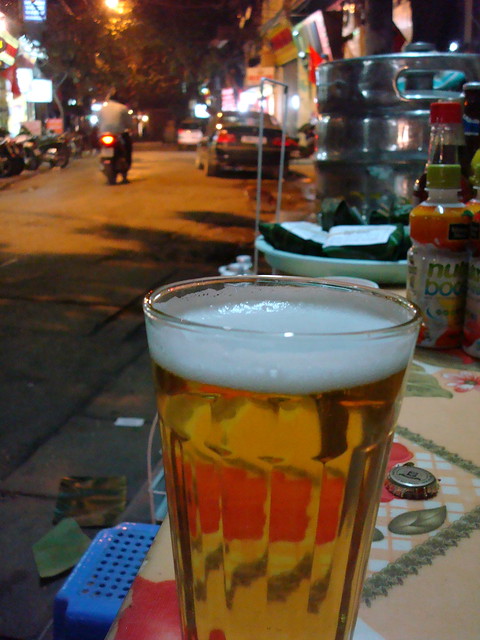
Maybe so. But I haven't checked that fact just yet. What I am sure of however, is that at 4,000 Vietnamese Dong (about $0.20) apiece, I could afford to have two. And so, on a chilly January night in Hanoi, I exchanged a pair of crumpled bills for my first taste of bia hơi.

It was after 10 p.m. when I found a vendor on Luong Ngoc Quyen, a short distance from the intersection known internationally as bia hoi corner. Curbside seating consisted of about a dozen knee-high, blue plastic stools, so I grabbed one and sat down to take my first swig of Hanoi lager. Light-bodied, low in alcohol, and extremely drinkable, I could see the appeal of whiling away a warmer afternoon at one of the many "gas beer" outlets around the city. In the winter though, fewer people seemed eager to sit outside sipping oat soda until last call. 

My beer didn't offer much in the way of aroma, but it was pleasantly carbonated, and produced a thick white head of foam. Complexity of flavor, on the other hand, is not something bia hơi aspires to. With a straw-like character and the faintest suggestion of hops in the finish, my glass of beer certainly wouldn't impress fans of the more inspired American craft brewers. It might be able to hold its own alongside some of the lighter Latin American lagers though. Personally, I had nothing to complain about—my stomach was full of the bánh mỳ I'd eaten for dinner, a comfortable hotel room awaited me nearby, and when it came to Vietnamese currency, I was still a millionaire. 

Pairing Beer with the Great Outdoors

On a steamy afternoon in mid-July, waiting out a thundershower at the Peekskill Brewery, I had an idea. Nothing earth-shattering mind you, but I jotted it down in the notebook I was carrying with me at the time. Which means that when the rain finally stopped it didn't drift off with the storm clouds. Perhaps it's the heat in Bangkok, or maybe I'm just pining for a pint of  Peekskill's dry, sessionable Hop Common, but I was reminded of that same idea again today. 

What if craft brewers positioned themselves to be the drink of choice for certain outdoor activities the way Coors, Miller, and Budweiser jockey to be the "official beer" of popular sports like baseball and football? Sure, the customer pool of NFL fans is considerably larger than the potential market for say, windsurfers, but then again, this audience will probably be more receptive to a product that isn't necessarily mainstream. Although last year, Anheuser-Busch made an attempt to court outdoor enthusiasts by choosing professional kayaker Eric Jackson as the face of their new American Ale. 

Which got me thinking—what would the beer sponsorship landscape look like if regional brewers got in on the action? How would they attract new drinkers if they were trying to partner with the Hawaii Surfing Association, or the American Hiking Society? Personally, I could see a scenario along these lines:
  • Long Trail Ale, an easy drinking altbier made for long distance hikers. 
  • For the dedicated cyclist, New Belgium's popular amber ale, Fat Tire.  
  • Kona's Longboard Island Lager, a drink to grab after a day in the surf.
  • Russian River's Damnation—meant for the kayaker who charges into rapids at full speed. 
  • Malty Hibernation Ale from Great Divide, a warming winter beer for serious snowboarders.
  • The dry-hopped Hazed and Confused, brewed for bold rock climbers by Boulder Beer Company. 
  • Lake Erie Monster, a hoppy windsurfing lover's IPA from Great Lakes Brewing Company.
  • Fresh Powder Milk Stout, Lake Placid's ode to skiing the Adirondacks.  
So, what do you think? Is there a perfect craft beer out there for your outdoor activity of choice?

Shine On

I knew I wouldn't want for good food on my first trip to the Lone Star State. For starters, it simply isn't the kind of place that does small helpings of anything. I was not, however, expecting to find so many suitable beers to wash down my meals with. Dozens is a low estimate.

Of the numerous local styles to choose from, I soon learned that the one oat soda you simply can't miss is Shiner Bock, brewed and bottled in the "Cleanest Little City in Texas." It was for sale nearly everywhere, and somehow, complemented most of what I ate during my brief visit. Especially the barbecue. In fact, my advice for anyone within a tank of gas from Hill Country is to head immediately to Lockhart, order some brisket at either Smitty's or Kreuz Market, and reach for the ram.

Now that I'm back at my editing desk in Brooklyn, I could really use a smooth, medium-bodied, ice-cold Shiner. It would certainly make this eighteenth-century philosophy go down easier. Unfortunately, Spoetzl doesn't currently distribute their dark lager to thirsty Northeasterners.