The Union Square Holiday Market is in full swing, the 30,000 lights decorating the Rockefeller Christmas Tree will be lit next week, and even without any snow on the sidewalks, retailers have turned Manhattan into a wonderland of tinsel, snowflakes, wreaths, and garlands. If you're not the kind of person that eagerly awaits the Yuletide, then it's probably time for a drink. Egg Nog or hot buttered rum are always solid options this time of year, but maybe you'd rather just have a glass of wine or a pint of beer. That and a good book.
In the current issue of the Village Voice, I choose and review five new books that any beer geek, wine connoisseur, or cocktail enthusiast will want to add to their library. Titles like To Have and Have Another, Allagash: The Cookbook, and How to Love Wine are all great resources for someone planning to throw a party in the next few weeks, but most people with an interest in ales, spirits, or oenology will find at least one of these books worth reading. I agreed with much of Mr. Asimov's wine manifesto and definitely enjoyed the Hemingway Cocktail Companion by Philip Greene, but I was especially pleased to include a cookbook highlighting craft beer. As far as I'm concerned, a good new beer publication is worth celebrating any time of year.
Showing posts with label snow. Show all posts
Strolling Around Suomenlinna
In many ways, Helsinki has the Swedish military to thank for its existence. During the eighteenth century, when the Kingdom of Sweden ruled much of what is now modern Finland, today's cultural and political capital was a relatively small town, with a population of roughly 1,000 citizens. Meanwhile, beginning in 1748, a massive stone fortress called Sveaborg (Viapori in Finnish) began to take shape on the nearby Susiluodot Islands in the Gulf of Finland. Built as a defense against Russia, the base at its peak contained close to six times as many people as the cluster of wooden buildings across the harbor. But Sveaborg and its garrison needed civilian goods and services, and over time they gave significance to the trading post on Sweden's eastern frontier.
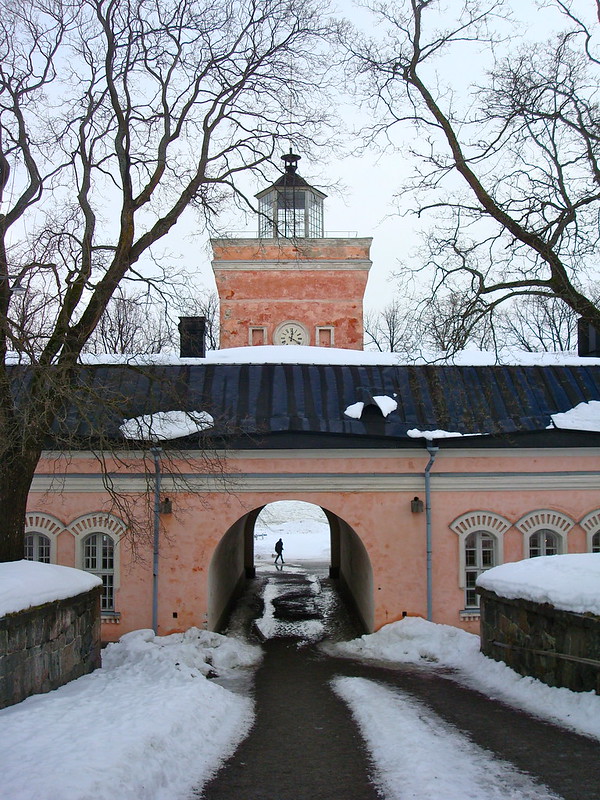
Today the tables have turned, and Suomenlinna, as the eight fortified islands are collectively known, has a fraction of its former population—about 850 at last count. On any given afternoon, most of the people wandering around the gravel footpaths and cobblestone avenues are tourists, visitors from other cities and countries eager to explore this UNESCO World Heritage site and maybe learn something about its history. Not long ago I was one of those wanderers, contentedly roaming around the rocky landscape as winter's snow began to melt. I brought my point and shoot camera over with me on the ferry, and shot a bunch of pictures as I covered the distance between the main quay and Bastion Zander, a mile walk to the south. The sprawling, painstakingly-restored complex is a scenic place to be sure, and even more inviting during the warmer summer months. I only wish the little ravintola panimo (restaurant brewery) had been open on the day of my visit. A pint of porter would've been good company while I waited for the boat back to Helsinki's Market Square.
Beer Tasting in Moose Country
There's a moose for almost every 53 people in Finland. And yet during a recent six day stay I didn't spot a single one. Plenty of snow and ice, but not so much as a glimpse of the enormous antlered herbivore. Well, except this guy. I photographed him in Hollola, a little town just outside of Lahti, near Lake Päijänne.
I had found my way to this medieval church village with the help of Pekka Kääriäinen, a well-known sahti advocate, entrepreneur, and head of the Finnish Association for Small Breweries. After spending the morning showing me all around his hometown, he'd insisted on introducing me to his friend Ilkka Sipilä, the owner of a place called Maaseuturavintola Hollolan Hirvi, or Hollolan Moose Countryside Restaurant. A place with a very small on-site brewery. And while it technically wasn't open for the season, the parking lot had been plowed, and Pekka assured me that it was no problem to drop by on a Friday afternoon in late winter. Plus, he explained over the pop music spilling from his car radio, sahti is still brewed the traditional way at Hollolan Hirvi—by adding heated stones to the mash tun instead of hot water—and I simply couldn't leave the country without meeting Ilkka.
Unfortunately, there wasn't a drop of the aromatic, juniper-infused farmhouse beer to be had when we arrived, so I settled for a taste of Tumma Hirvi, or Dark Moose (4.5% ABV), instead. Ordinarily a glass with set you back €6 (about $7.80), but turn up with a respected Finnish brewer and you'll likely get a complimentary pour. A thick, creamy beige head emerged as soon as my goblet was full, and leaning in to appreciate the smell, I found the nose reminded me of date cake or sticky toffee pudding. Five types of malt including caramel, Munich, and smoked malt, give this dark ale a full body and an ebony color with rosy highlights. Magnum hops are used for bittering, and Saaz to impart aroma. The finish is quite dry.
Ilkka demurred when I asked him about Tumma Hirvi's style, maintaining that he brewed for himself, not judges or beer freaks. "When we are brewing, we don't think about what category it should be," he told me. Depending on the season, farm guests can choose from a number of other unfiltered, unpasteurized beers as well as a meat-heavy menu of Finnish food. Beer-wise, I would've liked to sample Kivipukki (steinbock), American Moose (a pale ale), or French Moose (ale aged in cognac casks) and from the kitchen I might have ordered moose soup or a beer-marinated venison steak. I guess I'll have to try those on my next visit though.
Sure, lots of people think March is the month to look for cheap holidays to Goa or a quick escape to Ireland, but I say Finland deserves to be in the running, too. Bring a warm coat, a good pair of boots, and just in case you want to venture (naked) into a sauna, plenty of self confidence. If you're lucky, you might even see a moose. Travel to Hollolan Hirvi, and you'll definitely be able to taste one.
Unfortunately, there wasn't a drop of the aromatic, juniper-infused farmhouse beer to be had when we arrived, so I settled for a taste of Tumma Hirvi, or Dark Moose (4.5% ABV), instead. Ordinarily a glass with set you back €6 (about $7.80), but turn up with a respected Finnish brewer and you'll likely get a complimentary pour. A thick, creamy beige head emerged as soon as my goblet was full, and leaning in to appreciate the smell, I found the nose reminded me of date cake or sticky toffee pudding. Five types of malt including caramel, Munich, and smoked malt, give this dark ale a full body and an ebony color with rosy highlights. Magnum hops are used for bittering, and Saaz to impart aroma. The finish is quite dry.
Ilkka demurred when I asked him about Tumma Hirvi's style, maintaining that he brewed for himself, not judges or beer freaks. "When we are brewing, we don't think about what category it should be," he told me. Depending on the season, farm guests can choose from a number of other unfiltered, unpasteurized beers as well as a meat-heavy menu of Finnish food. Beer-wise, I would've liked to sample Kivipukki (steinbock), American Moose (a pale ale), or French Moose (ale aged in cognac casks) and from the kitchen I might have ordered moose soup or a beer-marinated venison steak. I guess I'll have to try those on my next visit though.
Sure, lots of people think March is the month to look for cheap holidays to Goa or a quick escape to Ireland, but I say Finland deserves to be in the running, too. Bring a warm coat, a good pair of boots, and just in case you want to venture (naked) into a sauna, plenty of self confidence. If you're lucky, you might even see a moose. Travel to Hollolan Hirvi, and you'll definitely be able to taste one.
The Winter Blues
We're one month into the new year already and so far the Northeast hasn't felt particularly wintry. Lately I've even found myself half wishing to be somewhere colder, or at least a little snowier. I didn't have this problem two years ago when I went to Iceland to research a story for Wend magazine. It was appropriately frigid during my time in the capital city. But before returning to Keflavik International Airport on my last day there, I made a short detour to a much warmer place that's practically become an obligatory stop for every visitor to Reykjavik: The Blue Lagoon.
Although the word lagoon is usually used in a tropical context, I suppose this popular geothermal spa, being a relatively shallow pool of water, technically isn't misnamed. What struck me about this quintessentially Icelandic attraction though, as much as the heat and the sense of calm that pervaded the whole complex, was the color. Even on an overcast day in February, the water seemed to glow, appearing a bright cyan or aqua against the drab surrounding landscape. Walking around after a dip in the famously therapeutic geothermal seawater, I snapped a handful of photographs that take me back to that day every time I look at them. Here's the set on Flickr.
The Blue Lagoon's 30 Euro entrance fee (about $39.40) isn't exactly inexpensive—especially when you add on another €5 for towel rental—but cheap holidays to Iceland do exist. Plan to travel in February or March and you'll get better fares and packages on Icelandair as well as lower hotel rates in Reykjavik. Sure, it'll be cold and dark, but spend enough time at a neighborhood bar, or better yet, a burger joint, and you're bound to meet a friendly Icelander or two.
Village Voice Winter Guide
While ice carving isn't exactly something I expect to think about (or frankly, see) in the next few months, I do know of a place where curious New Yorkers can go to watch sculptors at work: Walton Fairgrounds in the Catskills. And that's not all. If you happen to be in the mood for a winter seal walk, a dram of locally-distilled whiskey, or even a few hours of curling, I've got suggestions.
City vs. Country: Norwegian Edition
I made up my mind soon after arriving in Norway for the second time. The sparsely peopled, rugged nation simply couldn’t be understood—or fully appreciated for that matter—by exclusively observing life in its urban centers. I had to ditch the traffic, skip the shopping, and head for the hills.Not wanting to go it alone, I began to mentally scroll through the names of people I might persuade to join me. Almost immediately my friend Cathrine came to mind. Which makes sense I guess, given that I was sitting at her kitchen table when the idea hit me. So, breaking the ice with an idle comment about the favorable weather, I then suggested a hiking trip as we took the last bites of our breakfast one morning. “Are you sure you don’t want to see anything else in the city?” she asked skeptically.
A lover of restaurants, nightlife, and motorized transportation, I could see why Cathrine might initially be reluctant to trade these things for the pleasure of shivering next to me in a nylon tent. I let it drop. But at the end of an evening in which her drinking companions regaled us with tales of hunting moose and scaling peaks, she agreed that a woodsy weekend could be a nice change of pace. Especially after several aimless afternoons wandering the streets of Oslo. I have since decided to float all future hair-brained ideas across the seductive tides of a whisky snifter. A coffee mug only brings folly into sharper focus.
Discussing our adventures-to-be on the way home from the bar, we finally settled on Jotunheimen, a national park about 165 miles north of the capital. Home to the two tallest mountains in Northern Europe, it promised forbidding glaciers, punishing climbs, and the outside chance of spotting a frost giant. Fortunately she knew an actor who spent lots of time in higher altitudes and could lend us equipment, a good map, and his skills as an outdoorsman. Things we didn’t have, but might want to bring along—at least in her friend Haakon's opinion anyway.
Piling into a borrowed station wagon on an overcast afternoon, we sped north and westward, intending to set up camp that night and get an early start the next day. It wasn’t long after we awoke, shouldered our cumbersome packs, and set out however, that Cathrine and I came to the realization that we were in way over our heads. As in several feet. The pained look of concern we both wore on our faces became easier to read by the hour.
The day had begun with bright sun, hot food, and a brisk pace, but after a long morning of laboring across a field of car-sized boulders, my fondness for Mother Nature was flagging faster than my stamina. Pausing to catch my breath for the umpteenth time, I listened to Cathrine’s boots crunch against the smaller stones behind me and wondered where all the other hikers were. We hadn’t seen so much as a trace of another person since we broke camp, let alone evidence that anything living had come this way in a long, long time.
Another hour or so passed without much conversation, eventually delivering us to the day’s first real obstacle. As we paused at the edge of a steep snowfield, Haakon nonchalantly announced that the next step would be ascending a twenty-foot rock face without the aid of climbing gear. It dawned on me then that to your average Norwegian actor, the verb “to hike” bears virtually no resemblance to the definition commonly used throughout the rest of the world; i.e. a long walk, especially in the country, for pleasure or exercise.
Where I come from, a typical summer weekend is more likely to involve feats of eating than a test of anyone’s physical fitness. Not so in Norway. Calmly talking us through the handholds, he called down from the relative safety of the ledge above with a very matter-of-fact warning: “If you slip here, you’ll die.” Stupidly, I glanced down. While I stood there contemplating the likelihood of surviving a fall, I could feel the sweat pooling in the crevices of my waterproof clothing. The altitude amplified my exhaustion, and at that instant, my mind understood but one thing about Norway: the view from 7,000 feet can turn you into a city person very quickly.
My Voyage to Smoky Bay
Lured to the city of Reykjavík by a smörgåsbord of smoked, pickled, and fermented foods to try, I nonetheless ventured into the cold to document my visit. The lack of daylight made shooting outdoors more challenging, but at least the weather decided to cooperate. Travel with me in this set of photographs.
To come: my thoughts on putrefied shark.
Beer My Valentine
Nobody's ever given me flowers. Ditto fancy European chocolates. Heart-shaped jewelry isn't really my thing, but then they say it's the thought that counts, right? Well, with the most romantic day of the year nearly here again, I thought I'd offer a bit of sensible, wallet-friendly shopping advice for anyone who wants to sweep a guy off his feet this weekend.
Buy him a beer. He might not be the picky type, but don't just grab any bottle, go with something special. In other words, spring for a chocolate stout. Not every example of this style is made with real chocolate (relying instead on dark malts to produce a similar flavor), so read the label closely before snatching up your perfect Valentine's Day gift.
Ommegang brews a rich, intensely dark Belgian style chocolate stout that pours like velvet and leaves a wake of bitter cocoa behind. To call it indulgent is not an exaggeration. For my money however, Rogue's award-winning chocolate stout—silky, sweet, and full-bodied—has a slight edge. Like your favorite candy bar, it's irresistible. A couple of glasses of this kind of liquid happiness and neither you nor your sweetheart will care how many blizzards hit the East Coast this winter.
Remaining Focused
It's Christmas Eve and evidence of "The Blizzard of '09" still blankets suburban Maryland as I post some disappointing news. Back in September, I applied for a comic book self-publishing grant in the hopes of offsetting some of the expense of producing and distributing Captain Cartography. Unfortunately, I learned late last week that my proposal was not selected by the review committee and I won't be receiving any financial support from the Xeric Foundation.
While this is a setback, it doesn't spell the end for our spatially-gifted hero. In the time that has elapsed since I submitted my proposal, I've given more thought to the idea and continue to seek out and read comics that inspire me to keep writing. Plus, the advice and encouragement I've begun to receive from educators will help me relate my storyline to teaching standards as I move forward with the project in 2010. It may take me longer to develop than it would have with some funding, but I'm not giving up. Not yet. After all, I'm in this for the maps, not the money.
Subscribe to:
Posts (Atom)