Every once in a while an entire autumn afternoon will slip by as I gaze out the window, daydreaming about Scandinavia. For years I've told myself that one more trip will cure me of the urge to see another corner of this region, yet even before I get back home again I'm thinking about my next visit. But until I stumble into a pile of money, I'm going to have to content myself with infrequent tours and meals at bus terminals instead of swank restaurants like Rene Redzepi's Noma. Lucky for me cafeteria dining can also make for a good story.
It's been eight months since my last visit, a trip that included several days in Helsinki where the Finns were close to finishing their Baana cycleway. In the winter 2013 issue of Rails to Trails, I write about this new rail trail as well as longer routes in Denmark, Estonia, and Norway. The ice and snow on the ground kept me from biking around Finland's capital city, but hopefully I'll be able to do some two-wheeled exploring when I eventually make it back. Then again, a blogger by the name of Hendrik has me thinking that I might want to do some hiking too.
Showing posts with label finland. Show all posts
A Dispatch From Finland's Capital of Cool
Someday I'll travel to Scandinavia without a winter coat. I can't wait to leave my hat and gloves at home either. And who knows? Maybe I'll even throw a pair of shorts in my luggage, just in case. Lately though, I keep choosing the coldest months to visit Europe's northernmost countries.
First it was Iceland in February. I managed to keep warm with Brennivín and lots of coffee, but when the wind picked up off Faxaflói during the abbreviated afternoons, there was no mistaking the season. And then this year, during the second week of March, I flew to Finland to research a story on Helsinki, the 2012 World Design Capital. And while the ice in the harbor was beginning to show some signs of melting (dashing my hopes of walking to the Suomenlinna Sea Fortress), I always remembered to bundle up before venturing from the cozy confines of my hotel room.
The piece I wrote on Helsinki's stylish ways appears in the August/September issue of DestinAsian magazine. To see more of Finland, its chilly landscapes, and the delicious meals that distracted me from the temperature outside, check out my photo set on Flickr. As far as my next trip to Scandinavia goes, I'm not exactly sure when I'll be back. Yet a quick look at my calendar tells me that I don't seem to have much planned for January 2013.
First it was Iceland in February. I managed to keep warm with Brennivín and lots of coffee, but when the wind picked up off Faxaflói during the abbreviated afternoons, there was no mistaking the season. And then this year, during the second week of March, I flew to Finland to research a story on Helsinki, the 2012 World Design Capital. And while the ice in the harbor was beginning to show some signs of melting (dashing my hopes of walking to the Suomenlinna Sea Fortress), I always remembered to bundle up before venturing from the cozy confines of my hotel room.
The piece I wrote on Helsinki's stylish ways appears in the August/September issue of DestinAsian magazine. To see more of Finland, its chilly landscapes, and the delicious meals that distracted me from the temperature outside, check out my photo set on Flickr. As far as my next trip to Scandinavia goes, I'm not exactly sure when I'll be back. Yet a quick look at my calendar tells me that I don't seem to have much planned for January 2013.
Liquid Souvenirs From Finland
I've never really been one to buy souvenirs on trips abroad. Usually I'm traveling light, on a budget, or (more frequently) both, and don't often feel the need to spring for trinkets and keepsakes. There are, of course, a few exceptions to this self-imposed rule. Local craft beer is one of them, and since I started regularly writing about it, I've been fortunate enough to receive the occasional bottle or two of gifted brew.
Returning from Finland in mid-March, I managed to fit several beers into my suitcase, two of which were given to me by Pekka Kääriäinen, founder and managing director of Lammin Sahti Oy, a small brewery in the town of Lammi in the southern part of the country. Pekka is best known for his sahti, but he's also made ales and ciders for over a decade. Thanks to his generosity, I tried Juhlaolut as well as another called Pöllö, which translates simply to "owl."
To my eyes, Juhlaolut (7% ABV) has the color of polished rosewood: brownish with red highlights. Transparent but possessing slightly more body than I expected, it produced virtually no head when poured from the bottle. The nose was subtle with a musty vegetal aroma and a somewhat dull suggestion of hops. As far as taste, this "celebration beer" struck me as fairly subdued, with a soft caramel sweetness through the center and a gentle bitterness around the edges. Overall, Juhlaolut is a pleasant beer and more quaffable than the alcohol content implies. There's something likable about its malty, woody character, but I'm not necessarily anxious for a second sampling.
Interestingly, Pöllö's label lists the same five ingredients (vesi, ohramallas, humala/vatten, humle) and yet I found this ale more enjoyable to drink. In terms of a style, I would probably compare Pöllö to a Classic English Bitter. The color of bright copper—medium to deep amber—it too created very little head when served, much like the celebration beer. After I emptied the bottle, only a minuscule ring of tight bubbles clung to the walls of my Nonic pint glass. I did pick up some hop aroma though, along with a walnut-like sweetness and a good whiff of bready malt.
Lightly carbonated and relatively low in gravity, Pöllö (4.5% ABV) has a toasty malt profile that balances against a modest level of hoppiness. It finishes a bit dry and struck me as very sessionable. And while similar in some ways to the Juhlaolut's flavor, I could see myself seeking out this beer again. On the other hand, I might be just as likely to go looking for one of Pekka's two varieties of cider on my next visit to the land of lakes and saunas.
To my eyes, Juhlaolut (7% ABV) has the color of polished rosewood: brownish with red highlights. Transparent but possessing slightly more body than I expected, it produced virtually no head when poured from the bottle. The nose was subtle with a musty vegetal aroma and a somewhat dull suggestion of hops. As far as taste, this "celebration beer" struck me as fairly subdued, with a soft caramel sweetness through the center and a gentle bitterness around the edges. Overall, Juhlaolut is a pleasant beer and more quaffable than the alcohol content implies. There's something likable about its malty, woody character, but I'm not necessarily anxious for a second sampling.
Lightly carbonated and relatively low in gravity, Pöllö (4.5% ABV) has a toasty malt profile that balances against a modest level of hoppiness. It finishes a bit dry and struck me as very sessionable. And while similar in some ways to the Juhlaolut's flavor, I could see myself seeking out this beer again. On the other hand, I might be just as likely to go looking for one of Pekka's two varieties of cider on my next visit to the land of lakes and saunas.
Strolling Around Suomenlinna
In many ways, Helsinki has the Swedish military to thank for its existence. During the eighteenth century, when the Kingdom of Sweden ruled much of what is now modern Finland, today's cultural and political capital was a relatively small town, with a population of roughly 1,000 citizens. Meanwhile, beginning in 1748, a massive stone fortress called Sveaborg (Viapori in Finnish) began to take shape on the nearby Susiluodot Islands in the Gulf of Finland. Built as a defense against Russia, the base at its peak contained close to six times as many people as the cluster of wooden buildings across the harbor. But Sveaborg and its garrison needed civilian goods and services, and over time they gave significance to the trading post on Sweden's eastern frontier.
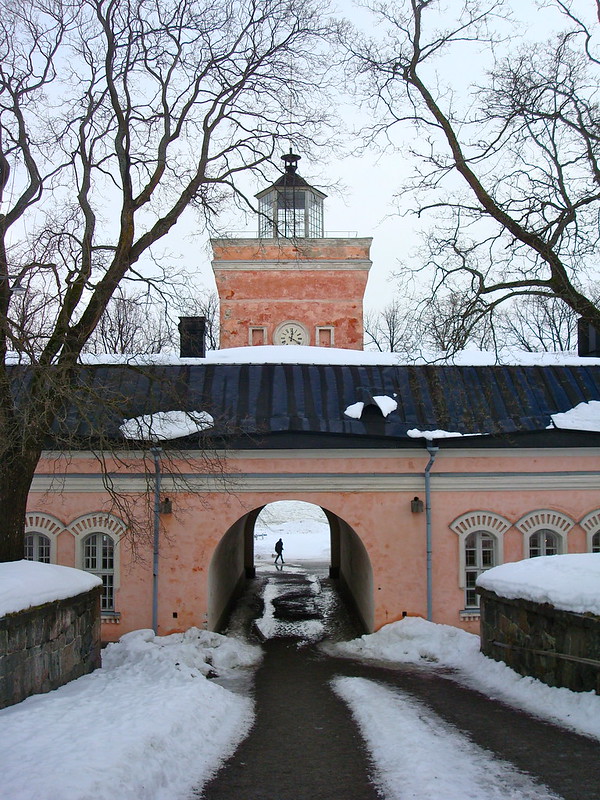
Today the tables have turned, and Suomenlinna, as the eight fortified islands are collectively known, has a fraction of its former population—about 850 at last count. On any given afternoon, most of the people wandering around the gravel footpaths and cobblestone avenues are tourists, visitors from other cities and countries eager to explore this UNESCO World Heritage site and maybe learn something about its history. Not long ago I was one of those wanderers, contentedly roaming around the rocky landscape as winter's snow began to melt. I brought my point and shoot camera over with me on the ferry, and shot a bunch of pictures as I covered the distance between the main quay and Bastion Zander, a mile walk to the south. The sprawling, painstakingly-restored complex is a scenic place to be sure, and even more inviting during the warmer summer months. I only wish the little ravintola panimo (restaurant brewery) had been open on the day of my visit. A pint of porter would've been good company while I waited for the boat back to Helsinki's Market Square.
Beer Tasting in Moose Country
There's a moose for almost every 53 people in Finland. And yet during a recent six day stay I didn't spot a single one. Plenty of snow and ice, but not so much as a glimpse of the enormous antlered herbivore. Well, except this guy. I photographed him in Hollola, a little town just outside of Lahti, near Lake Päijänne.
I had found my way to this medieval church village with the help of Pekka Kääriäinen, a well-known sahti advocate, entrepreneur, and head of the Finnish Association for Small Breweries. After spending the morning showing me all around his hometown, he'd insisted on introducing me to his friend Ilkka Sipilä, the owner of a place called Maaseuturavintola Hollolan Hirvi, or Hollolan Moose Countryside Restaurant. A place with a very small on-site brewery. And while it technically wasn't open for the season, the parking lot had been plowed, and Pekka assured me that it was no problem to drop by on a Friday afternoon in late winter. Plus, he explained over the pop music spilling from his car radio, sahti is still brewed the traditional way at Hollolan Hirvi—by adding heated stones to the mash tun instead of hot water—and I simply couldn't leave the country without meeting Ilkka.
Unfortunately, there wasn't a drop of the aromatic, juniper-infused farmhouse beer to be had when we arrived, so I settled for a taste of Tumma Hirvi, or Dark Moose (4.5% ABV), instead. Ordinarily a glass with set you back €6 (about $7.80), but turn up with a respected Finnish brewer and you'll likely get a complimentary pour. A thick, creamy beige head emerged as soon as my goblet was full, and leaning in to appreciate the smell, I found the nose reminded me of date cake or sticky toffee pudding. Five types of malt including caramel, Munich, and smoked malt, give this dark ale a full body and an ebony color with rosy highlights. Magnum hops are used for bittering, and Saaz to impart aroma. The finish is quite dry.
Ilkka demurred when I asked him about Tumma Hirvi's style, maintaining that he brewed for himself, not judges or beer freaks. "When we are brewing, we don't think about what category it should be," he told me. Depending on the season, farm guests can choose from a number of other unfiltered, unpasteurized beers as well as a meat-heavy menu of Finnish food. Beer-wise, I would've liked to sample Kivipukki (steinbock), American Moose (a pale ale), or French Moose (ale aged in cognac casks) and from the kitchen I might have ordered moose soup or a beer-marinated venison steak. I guess I'll have to try those on my next visit though.
Sure, lots of people think March is the month to look for cheap holidays to Goa or a quick escape to Ireland, but I say Finland deserves to be in the running, too. Bring a warm coat, a good pair of boots, and just in case you want to venture (naked) into a sauna, plenty of self confidence. If you're lucky, you might even see a moose. Travel to Hollolan Hirvi, and you'll definitely be able to taste one.
Unfortunately, there wasn't a drop of the aromatic, juniper-infused farmhouse beer to be had when we arrived, so I settled for a taste of Tumma Hirvi, or Dark Moose (4.5% ABV), instead. Ordinarily a glass with set you back €6 (about $7.80), but turn up with a respected Finnish brewer and you'll likely get a complimentary pour. A thick, creamy beige head emerged as soon as my goblet was full, and leaning in to appreciate the smell, I found the nose reminded me of date cake or sticky toffee pudding. Five types of malt including caramel, Munich, and smoked malt, give this dark ale a full body and an ebony color with rosy highlights. Magnum hops are used for bittering, and Saaz to impart aroma. The finish is quite dry.
Ilkka demurred when I asked him about Tumma Hirvi's style, maintaining that he brewed for himself, not judges or beer freaks. "When we are brewing, we don't think about what category it should be," he told me. Depending on the season, farm guests can choose from a number of other unfiltered, unpasteurized beers as well as a meat-heavy menu of Finnish food. Beer-wise, I would've liked to sample Kivipukki (steinbock), American Moose (a pale ale), or French Moose (ale aged in cognac casks) and from the kitchen I might have ordered moose soup or a beer-marinated venison steak. I guess I'll have to try those on my next visit though.
Sure, lots of people think March is the month to look for cheap holidays to Goa or a quick escape to Ireland, but I say Finland deserves to be in the running, too. Bring a warm coat, a good pair of boots, and just in case you want to venture (naked) into a sauna, plenty of self confidence. If you're lucky, you might even see a moose. Travel to Hollolan Hirvi, and you'll definitely be able to taste one.
Juniper in June
Fortunately, Bierkraft in Brooklyn has begun to carry (at least for the time being) a tasty Swedish/Norwegian sahti brewed and bottled at Nøgne Ø in Grimstad. I tried a bottle of it after dinner last night and thoroughly enjoyed its sweet, herbal character. Eleven percent alcohol by volume and made with rye, wheat, juniper twigs, sea wormwood, plus a generous dose of honey, it's not for everyone, yet if you have an adventurous palate, sahti is well worth trying.
Similar in some ways to Rogue's flavorful Juniper Pale Ale, this cloudy, somewhat tart drink produces an ample head of beige foam and pours a burnt orange or medium amber color. I'm not sure if this type of beer tastes best after a marathon sauna session or a Lordi concert, but I do hope it helps me crank out a review of Hanne Hukkleberg's new album Blood From A Stone later this week.
Subscribe to:
Posts (Atom)