Showing posts with label thailand. Show all posts

Bangkok as a Beer Destination

Two and a half years ago, I boxed up my things, packed a pair of bags, and moved to Bangkok. The food—as expected—was phenomenally good, the omnipresent heat took some getting used to, and the beer, well, I hadn't counted on any surprises. Then I discovered the Belgian beer bar in Ari, my new neighborhood. I couldn't afford to drop by as often as I wanted to, but just knowing a place with Leffe on tap existed in Thailand made me that much happier to be there.

Earlier this year, I returned to Southeast Asia to see friends and research several assignments for a few different magazines. One of these articles covers Bangkok's beer scene and appears in issue#78 of BeerAdvocate (July 2013). Not only did I enjoy going back to old favorites like House of Beers, I also happily spent time at newer bars and beer focused restaurants like Brew Beers & Ciders and Shuffle at Rain Hill, a recommendation from Brian Bartusch and Aaron Grieser, the guys behind Beervana Trading Company. Sitting around their busy Bang Na office while drinking a Poleeko Pale Ale, I got the sense that craft beer had become more than something trendy to add to menus catering to a moneyed clientele. Slowly but surely it's earning a place in Thailand's sophisticated food culture. I can't wait to see what's changed the next time I visit.

What's Cooking: Queens Gains a Homebrew Club

It all started with a simple idea. Gather a bunch of homebrewers, give them a short list of ingredients to work with, and let them do what they like to do most. There was only one catch: brewing beer, like event planning, might appear simple to execute at first glance (or taste, as the case may be), but actually involves a relatively complicated process.

Fortunately, I had Brewstoria to help me. Founded by Astoria resident Ryan Crook in 2010, this homebrew club has since grown rapidly and had been looking for a chance to involve a bunch of its members in a larger, collaborative brew day. As for the ingredients, I decided to challenge them with spices from Thailand, additives that aren’t commonly found in beer recipes but do appear at many a grocer across Queens—ginger, Thai basil, cilantro, chili pepper, and lemongrass. Theoretically, any one of these adjuncts could work with the right beer, and I was curious to found out just how creative the Brewstoria crew could be. Plus, if this borough really is the most diverse in a city that already represents America as melting pot, it only seemed fitting to add a dash of international flavor to the proverbial brew kettle. To my delight the group didn’t just accept the idea, they embraced it.

Being the industrious, let’s-get-right-to-it, sort of people that homebrewers usually are, they managed to make arrangements to use the kitchen and courtyard at The Foundry, an event space in Long Island City. And by the time I turned up on a sunny Sunday morning last February, things were nearly in full swing. Six teams had set up at indoor and outdoor brew stations, and the air was already thick with promising smells. Fittingly, I also caught a few stanzas from a Red Hot Chili Peppers song floating from a pair of portable speakers.

Intoxicating Bangkok

Not long after I moved to Thailand's capital city in late 2010, I discovered something I hadn't counted on: a beer scene on the rise. With each week that went by, another European import (and even the occasional microbrew) would turn up on a menu or tap list somewhere. For a beer advocate like me, this was good news. Last summer, Beer Connoisseur published a feature story I wrote on the growing number of brewpubs and trendy beer bars in Bangkok. In it I mention Tawandang German Brewery and Est. 33 by Singha, two businesses that have since opened new branches at Siam Discovery Center and The Nine on Rama 9 Road.

As far as I can tell, the pace of change hasn't slowed much, if at all. Chris Foo, of House of Beers, or HOBS, recently launched BREW Beers & Ciders in Thong Lor, while Silom has added The Pintsman and The Nine made room for Einstein Café, yet another place to find witbier and pale European lager on tap. American brands haven't joined the party yet, but friends tell me that it is possible to track down an IPA (by which I mean Carlow Brewing's dry-hopped Irish Pale Ale). My article isn't online, but here's a brief excerpt:  
"Built to be the "ultimate lifestyle design district" with dozens of showrooms peddling fine furniture, expensive kitchen and bath products, luxury house ware, and modern home entertainment accessories, CDC [the Crystal Design Center] has surprisingly emerged as an oasis for beer buffs as well. Restaurants soon followed interior design companies to this shopping complex, and then at the beginning of the year, Est. 33 was joined by the Aston Gastro Bar and Beerology. These specialty bars aren't trying to compete with the typical Thai beer garden crowded with tin tables and taste-alike beer; they're aiming to attract tastemakers. In a city where a bottle of Chang is usually about 70 Thai baht of $2.30, they charge closer to $8 for a bottle of Tripel Karmeliet."

Need a Physician? Bring a Passport

No, that's not a hotel interior. It's a VIP suite at a medical facility in Southeast Asia. And not even the most expensive inpatient accommodation available at Bumrungrad International Hospital—that would be the Premiere Royal Suite. Honestly, I found it difficult not to be a little gobsmacked the first time I saw rooms like this in person.

I mention this because I wrote a short article on Thailand's medical tourism industry last year. My editor at Tropical magazine called it "Comfort and Care: Thailand's Perennial Allure to Health Travelers," and at the end, I quoted a source who claimed that countries such as Poland, Hungary, and Costa Rica are challenging heavyweight healthcare destinations like Thailand. Many months later, flipping through the "Journeys" issue of the New Yorker, I found myself reading James Surowiecki's financial column before any of the longer travel features. This in spite of the fact that I hadn't eaten dinner yet and the magazine included an intriguing story on Russia's lost culinary heritage.

The Truth About Elephant Trekking

Few experiences can compare with meeting one of the world’s largest vegetarians. Up to ten feet tall at the shoulder, Elephas maximus, better known as the Asian elephant, is the very definition of a gentle giant, happy to accept a spiny pineapple or a bunch of ripe bananas from an awestruck two-legged visitor. According to biologists, perhaps as many as 100,000 members of this species occupied Southeast Asia in the early 1900s, but in the century since, these animals have seen their range steadily shrink as logging, slash and burn agriculture, and a growing human population encroach on the tropical and subtropical forests pachyderms depend on for survival. Poaching and habitat fragmentation further threaten the small numbers that exist in the wild in Thailand today, now largely limited to national parks such as Khao Yai and Khao Cha Mao, as well as isolated tracts of land along the Cambodian, Laotian, and Myanmar borders.

While their numbers in the wild have decreased, their popularity as a tourist attraction has only grown, due in part to the government ban on logging that effectively put many domesticated elephants out of work. At present, the Tourism Authority of Thailand (TAT) lists nearly four dozen tour operators that offer short rides or longer treks. Clearly elephants are big business. But what kind of business exactly? These highly social animals require lots of fresh water and about 330 pounds
(150 kg) of food per day, not to mention quite a bit of space. So how are they trained and cared for? A phrase on the TAT website offers a telling if disappointing clue: “the treatment of Thai elephants varies from elephant camp to elephant camp, some using more humane methods to look after their elephants than others.”

According to Timothy Gorski, director of the documentary How I Became an Elephant, the boom in elephant tourism began in the 1980s and has risen with "the so-called ‘eco-tourism’ phenomenon. Elephant treks are being marketed as eco-friendly conservation tours.” Problematically though, the definition of eco-tourism often differs from company to company, and training methods—rarely witnessed but captured in Gorski’s documentary—are often cruel. The pajaan, a practice that involves caging a young elephant and depriving it of food, sleep, and even contact with its mother, is one such method. In addition, some say that health and safety regulations are minimal and inadequately enforced. As a result, Catherine Bodry, co-author of the last edition of Lonely Planet Thailand, maintains that the long-term well being of elephants in Thailand is largely up to tourists and the general public. But if the future of the Asian elephant depends on public awareness and action, education must be a part of any trek. Unfortunately, this isn’t something that every camp provides.

Road Tripping From Bangkok

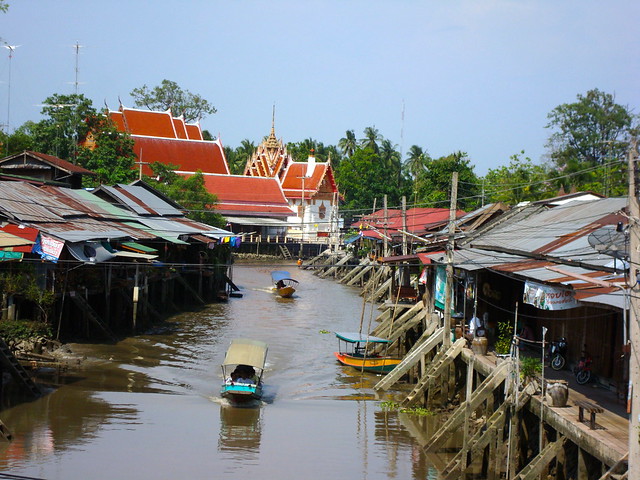
Every year millions of tourists flock to the Kingdom of Thailand, eager to see the Grand Palace, snorkel in the Andaman Sea, or maybe expand their culinary horizons. Well, whether or not they're aware of it, most of these people end up covering the same well-worn tourist trail: Bangkok, Chiang Mai, Phuket, Ko Samui, and Ko Phi Phi. Which isn't to say that these places aren't worth visiting, it's just that there's so much more to this country that you'll never really see from the window seat of a puddle jumper. I made more than a few overland journeys during the months I spent in Thailand, but one of my favorite trips was a drive south from the capital along the Gulf coast to Khao Sam Roi Yot National Park. Over the course of a long weekend, I learned a bit more about the region's history, tried a ton of incredible food at the Amphawa floating market (pla meuk yang anyone?), and documented my stops with a smattering of photographs.

A Spring Cleaning

Two weeks ago I found myself running for my life. The day before, my friends and I had turned up in Sangkhlaburi, a sleepy little town near the Burmese border at the northern end of the Khao Laem Reservoir. Only we were arriving during the one time that the entire country of Thailand happens to be wide awake: the Thai New Year. Better known as Songkran, this famously boisterous holiday can trace many of its traditions back to the fourteenth century and the kingdom of Ramathibodi in Ayutthaya.

Flash forward to the present however, and I'm sprinting from a pack of heavily armed, Hawaiian shirt-wearing assailants in a futile attempt to stay dry. Because while Thais do observe the holiday in a variety of ways, the celebration today is defined by a prolonged, nationwide water fight. And I hadn't brought anything to defend myself with. Far from menacing, the kids in town nonetheless knew how to use their squirt guns and water buckets, and took great pleasure in drenching a conspicuous group of farang. View more pictures from the Songkran Festival in my Kanchanaburi photo set.

A Dispatch for DestinAsian

Thailand has roughly 450 kilometers of expressways. Occasionally, it can feel like every other person in the country is using them to get somewhere at the same time. For that reason, driving here is not always a pleasant experience. As for the rules of the road, the Rough Guide to Thailand helpfully remarks that "there are few rules that are generally followed—you'll need to keep your concentration up and expect the unexpected." Fodor's meanwhile, sums up the situation much more bluntly: "Driving in Thailand is not for the faint of heart."

Traffic and safety concerns aside, a road trip through this complicated nation does yield rewards, as I discovered while on assignment for DestinAsian magazine. In a piece entitled "Thailand Uncorked," I traveled to Khao Yai, where several members of the Thai Wine Association are working together to promote a wine trail. Driving between the three vineyards featured in my story, I got a glimpse of Thailand that you'll never see by sticking to bus routes and train lines. In fact, if it weren't for my road trip to wine country, I might never have discovered Palio Khao Yai.

Southeast Asia's Little Italy

Last Sunday was a strange day. Following an afternoon spent puttering around the oldest national park in Thailand, I ended up eating dinner at one of the country's newest attractions: Palio Khao Yai, a "walking street shopping center in Italian-style village mall." Got that? A personal recommendation had led my friends and I to hunt for a burger joint south of the town of Pak Chong, and after mistakenly driving past a vaguely European complex, we found ourselves paying 20 baht each to enter this warren of terracotta-colored buildings. Call it the Little Italy of Southeast Asia.

As out of place as it seemed architecturally, what struck me about Palio was its obvious allure to amateur Thai photographers. While we were there, dozens of people streamed through the gate, usually in couples, and always with cameras. I smirked as they posed in front of the fountain in the piazza, and shook my head in disbelief as they led tiny dogs in sweaters down faux-cobblestone streets. Apparently the ability to shoot portraits against a "Tuscan" backdrop trumped the appeal of creatively-named cafes like Fries Me To The Moon.

It seemed silly to me at the time, but when I thought about it later, I realized that I'd misjudged things. After all, whether or not it's international, a big part of travel is making memories, and for most of us, taking pictures is part of that process. Did I really think that my images of waterfalls and wildlife somehow showed a more authentic side of Thailand? True, I'm the kind of person who prefers hiking to shopping, but a park is a tourist attraction too, and in the end, they're all competing for visitors. In that sense, maybe Palio Khao Yai isn't such a strange place to spend a Sunday.

Thailand's Ice Cream Innovation

With less than a week remaining in February, the temperatures have begun to creep up in Bangkok. This is of course, a sure sign of one thing and one thing only—the approach of the Hot Season. Gone are the tolerable eighty-degree days when a welcome breeze might stir the bougainvillea on a quiet soi in Ari. Slowly but unquestionably they're being replaced by oppressive humidity and baking heat. Needless to say, this isn't good news for anyone, least of all those of us who break a sweat just thinking about the long walk to the SkyTrain. 

Fortunately, like the people themselves, Thai street food has adapted to the climatic extremes of Southeast Asia. And so, where a lemonade or a granita might do in another city, there's only one warm weather treat that can offer adequate relief for Bangkok's steamy afternoons: Coconut Ice Cream. Served in a cake cone or (preferably) on a hot dog roll, this inexpensive, frozen confection is typically cold enough to make your teeth ache with their first frigid bite. For the full experience, order it with roasted peanuts, sticky rice, sweetened gelatin, candied sweet potato, and to top it all off, a generous pour of condensed milk.

The 5 Best-Kept Secrets About Ko Phi Phi

One of the most popular destinations in Thailand, Ko Phi Phi Don might also be one of world’s best-known islands. Every day ferries deposit scores of sun-worshippers and partygoers on the shores of this limestone landmass in the Andaman Sea. I made my own trip there with some friends a few years ago, and plan to go back before 2011 is over. It really deserves the hype. And although you don't have to stay long to appreciate its appeal, Phi Phi also has a few secrets to reveal to those who come looking. 
  1. The Soundtrack. Forget the beach—well, not entirely—and acquaint yourself with the marine life inhabiting the lagoons of Ko Phi Phi Leh, Phi Phi Don’s little brother next door. While tour groups crowd the strip of sugary white sand seen in The Beach, grab fins and a snorkel to hear one of the most remarkable sounds beneath the waves: hundreds of blue parrotfish munching and crunching on coral.
  2. The View. Sure, cocktails and camaraderie are great for a while, but don’t fall into the trap of spending all your time in Ton Sai Village. Swap out your flip flops for sturdier footwear and head uphill for stunning views above Ao Loh Dalum and Ao Ton Sai. The walk to the top is no more than 25 minutes and adventurous visitors can descend the east side of the island to reach a trio of secluded beaches. 
  3. The Scenery. Sunbathing and swimming definitely have their merits, and Phi Phi doesn’t lack for nightlife. Yet with its tranquil coves, busy docks, plentiful sea birds, and favorable lighting, it’s also a photographer’s dream. Do some scouting when you arrive, and then wake up early the next morning for an hour or two of shooting.  
  4. Peace and Quiet. Given the crowds, Phi Phi might not seem like a place to get away from it all. But many day-trippers and overnighters stick to the sandbar connecting the cliffs of Ko Nok with those of Ko Nai. For a more relaxed environment, hire a longboat to Laem Tong at the north end of the island, where the accommodations offer a refreshing alternative to the busy bungalows in the south. 
  5. Its History. Not far from Laem Tong a community of chao ley, or sea gypsies, have established a small village just beyond the hotels. For several hundred years these nomadic people have made a living fishing, collecting shells, and bird-nesting in the waters of the Andaman. The chao ley retain a distinct language and culture in spite of efforts by the Thai government to promote assimilation.

Live From Bangkok

It was quite possibly the darkest, heaviest version of "Every Breath You Take" I've ever heard. Almost as if Joy Division and Metallica had decided to collaborate on a song that Sting himself admits to being his most sinister. But the rock band playing the Grammy Award-winning single wasn't British or even American for that matter, and probably count few fans outside of their native country. 

In fact, Ynot7 is a talented group of Thai musicians that recently emerged from a lengthy hiatus in an attempt to recapture some of the success they enjoyed with their previous albums. On Sunday night, I caught the first concert in their weekly residency at Parking Toys, an eclectic venue in Bangkok's Lat Phrao neighborhood. In addition to a bunch of originals I didn't recognize, they covered "Enter Sandman," "Smoke on the Water," and "Another Day in Paradise." Recordings of these songs aren't available online, but you can watch the official video for "On the Wall," their newest single, on YouTube.

Bangkok's Belgian Oasis

In a way, the Jean-Claude Van Damme movie was strangely appropriate. But it was pure coincidence that HBO happened to be showing Street Fighter when I sat down at the newest branch of Bangkok's House of Beers and ordered a Leffe Brown. Deciding I wanted something other than noodles for lunch, I had wandered down to Aree Garden in search of pub grub and a malty ale. Little did I know that the Muscles from Brussels would be on the menu, too.

I also didn't anticipate the range of beers that I'd be able to choose from, with nary a domestic brand among them. Besides predictable draft standards like Hoegaarden and Stella Artois, HOBS carries more than two dozen Belgians in bottles, including Trappist ales from 
Rochefort, Orval, and Chimay. In fact, they claim to have the greatest Belgian beer selection in Thailand.

True or not, I expect to be back in the near future, probably on another quiet afternoon when splurging on a drink seems like a good excuse to leave the house. With tax and tip, my bill came to 601 Baht (about $20) for the Leffe and a croque madame accompanied by fries and a small salad. Not exactly a bargain, but definitely worth it if I can watch Timecop on my next visit.

I Was Waiting To Be Struck By Lightning

Maybe it's all the rain. Or perhaps I'm actually a melodramatic person. I suppose there's also the possibility that I have a Scottish cell or two in my bloodline. Whatever the truth may be, I can't stop listening to Camera Obscura's new album, My Maudlin Career. Songs like "The Sweetest Thing," and "Swans" are fantastic, four-minute synopses of emotional devastation. With lines like "When you're lucid you're the sweetest thing/I would trade my mother to hear you sing," it's clear that lead vocalist Tracyanne Campbell endows her lyrics with a peculiar Glaswegian sensibility, but it's the rest of the band that really elevates the music from mere pop to sheer poetry.

What I find most appealing about this quintet is that so many of their compositions involve a solitary journey: in pursuit of a feeling, to reunite with or escape from a person. Others lament being alone somewhere, or express a desire for another place, another time. We travel for lots of different reasons, reasons that occasionally change mid-trip. It's curious to me that the experience itself can often produce feelings we didn't expect to have at all.

A couple of years ago, towards the end of a ten-day trek through Thailand, I found myself standing on Hat Rai Leh underneath limestone cliffs and an inky night sky that seemed to stretch infinitely westward. The friends I was traveling with had gone to bed, tired after an afternoon spent fighting the Indian Ocean's tides. Our Asian holiday had been thoroughly enjoyable thus far, and yet as my mind drifted off with the sound of the surf breaking at my feet, I was overcome with an intense feeling of loneliness. Suddenly I longed to see the girl I'd been dating for the past six weeks. And the longer I stood there on the beach, the deeper the pit in my gut became.

I could have used Camera Obscura then. Something with swooping strings, a throbbing bass, a bright horn part, and plenty of jangly tambourine to drown my mood with noise. A song to tell me I'd been struck by lightning.